
Last week, my job was to go to Baucau and provide solar power and solar hot water for a friend working in the
Seeds of Life Program (agriculture). It was a great opportunity to put in a gravity fed solar hot water system which we are building here in East Timor from locally available materials. Just in case you wanted to build your own or were intrigued as to how I did it here’s my little explanation. Its a rip-snorter of a system really.
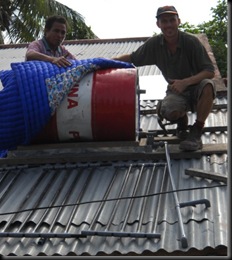
You’ll need a 44 gallon drum (204L general fuel drum), about 8 lengths of 1/2” plastic pipe, 4 lengths of 3/4” plastic pipe, a bunch of T-fittings and other plumbing bits, some 3”x2” timber, insulation, flat sheet metal, glue, screws and nails etc. Basically stuff we can buy here from the local hardware shop.
We made a rectangle frame of timber and nailed some flat tin on the bottom to keep the mice out – this holds the old drum.
To insulate the drum, we covered it with a mattress which the Timorese make out of kapok – its like cotton wool only from a tree. (In the old days they used to stuff life-jackets with it.) You could use old rags or an old foam mattress I suppose. The Timorese man I was working with was very confused about why I’d want to lay a perfectly good drum on its side, on the roof and cover it with a mattress!!! These white skin folk are truly crazy. By the end though, he was convinced that this was a new business opportunity for him as he could see that he could build solar hot water systems using things he could buy and skills he had. The only thing he lacked was the technical design which he learnt on this day.

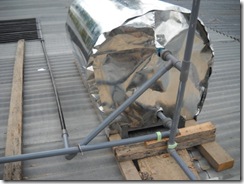
This then gets covered over with a sheet of flat ‘tin’ (actually a sheet of zinculume roofing iron). You can see my metal working skills are at a rather fundamental level minus the ‘funda’.
The fun bit is making the solar collector. We are in the tropics so we just scrapped the whole glass box thing. I really think its superfluous for anyone below the 30th degree of latitude. I just cut all these plastic pipes up at around 2m long and glue them together with T-pieces. Its so simple you should have thought of it yourself. (Note, for those who are actually going to try this, that the sequence in which you glue it together is a bit tricky, put some thought into it)
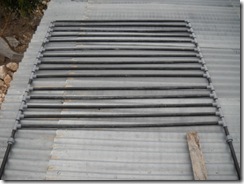
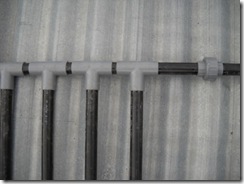
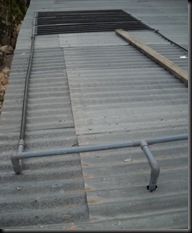
Plumbing it into the drum takes a bit of thought. Solar hot water works

on the principal of thermosyphoning – hot stuff rises (like me really) and cold stuff sinks. So at the bottom of the drum a pipe comes out to go down to the bottom of all the vertical tubes. (Note that I screwed this straight into the small hole in the drum, its a 3/4” fitting). The sun heats up the water in the tubes, it rises up and finds its way back into the top of the drum. I made my own little hole for a 3/4” fitting by using a small drill bit and drilling little holes around in a circle. (For the techno buffs, the messy hole I create receives a 3/4” steel nipple fitting which sort of threads its own hole in and then I plug it up with silicon.) The big hole in the drum is left for inspection and also to allow air trapped above the hot water intake to escape.
The single most important thing to get right is to allow for the expansion and contraction of hot water. If you stuff this up the whole thing could blow up. I just put in a rising pipe which goes up higher than the water in the holding tank (the holding tank is on a small hill behind the house, water comes into the solar hot water system by gravity.
The second most important thing is to make sure that the hot water goes uphill all the way from the vertical pipes into the drum and the cold water in the drum goes downhill all the way to the bottom of the vertical pipes.
And hey presto! Hot water.
The whole thing cost us about $25 in bits. Takes a day or so to build and mount.
PS If you live in one of those rich, fancy countries stuffed with heaps of rules I suspect this would be somewhat on the illegal side, so just forget I ever told you.
PPS If you want to pull this off under a pressurised system (like a pump) there is a simple way. If you cant figure it out, ask your grandfather. If he cant figure it out, email me.



 These are garden beds put in by the Nazarene church youth in an attempt to get some income. These are full of dead vegies – hope that dried up when their bore failed. Its now late into the dry season and their bore was not bashed down far enough. I am trying to help them get the bore down further. Just on the quiet, I’ve never done boring work before. The farm I grew up on relied on a spring further up the hill and the water came down by gravity. But now, in true naive style I have been dubbed the expert. We employed a guy to do the work but the chain on the pulley he uses to pull up the bore pipe snapped and he has given up. I bought a three tonne pulley (block and endless chain type) and with a bit of grunting in the bottom of the dry well with a Timorese and 200 mozzies we somehow managed to pull out the pipe.


