Monday, May 25, 2015

Bond beam getting poured

The boat came back from Atauro with a number of water filters and some grinders being sold.  Other products were left with key people in each village who may sell them over the next month.

This week on the training centre the team poured the “bond beam”.  This is a steel reinforced beam around the the bottom of all the walls.  The trick with this is to make sure any plumbing and electrical (and communications and sound) that are coming up from the floor are already set into the beam.  Anen has done a great job with trying to get all the wires and pipes in the right places (considering these people are more skilled at building grass huts than 2 storey buildings).

2015-05-23 11.56.34

Pouring the concrete to make the bond beam.  Note the electrical cabling is set in wherever they hope to put a power point.


The reo steel is made of 10mm steel rod and 6 or 8mm loops that curve around the outside.  As I am Australian and the builders are Timorese we constantly have disagreements about what is important for strength.  I try to stay patient and positive at this point.

2015-05-23 11.59.50

Reo is tied up with dedication – apparently the more loops the stronger it is!

“Boxes” of plywood are made up around the steel to pour the bond beam.  Note that they do not lay a slab at this point.  In fact, in this part of Asia they rarely lay a slab preferring instead to lay floor tiles later on a 50mm bed of mortar.  This is partly because their building process is quite messy with lots of concrete being splashed everywhere.

2015-05-23 11.59.18

Plywood “boxes” ready for concrete to go in.

Anen wants to fill up all the inside of the building with soil after this and lay down a thin layer of concrete to help with the rest of the building process.

2015-05-23 11.57.00

Its a steaming hot country but they choose to wear long sleeves, with Apoli on the right working in a thick hoodie.2015-05-23 12.01.27

Lucas’s recording studio with pipes in the ground to take sound cables from the desk to the sound room (behind) and from the desk to the front of the training room.


The costs are already exceeding my estimations but I hope I’ll make it up further down the line.

Budget for the building (US$):

Costs so far: $9500

Contributions: $7500

Sunday, May 17, 2015

Voyage of New Technology

Yesterday we were able to see our little ship off to embark on a circumnavigation of Atauro, the island north of Dili.  They are loaded up with a couple of drums for corn storage, the next generation of water filter sets, improved food grinders and a new product for Timor-Leste:  chicken wire!

IMG_0264

Our beautiful boat after a recent makeover where Tobias (left) has given the roof a new paint job and more importantly plugged the hole underneath.  Note the pot plant heading to the island!

IMG_0278The white buckets are the new filter sets.  Its a food grade plastic specially imported for the job.  It sports a new dome ceramic filter with activated carbon inside and impregnated with silver, a dispenser tap and sticker to explain how to clean the filter and contact details for replacement.  With a total of 40L of water storage, I think some Timorese families value it as a convenient water storage device more than its ability to provide safe drinking water.  One system like this will set them back $25.  Tobias and Emmy sold five at the first village they stopped at.  They have 25 big sets and 24 medium sets to be delivered to at least 5 villages around the island.

Corn is the staple diet of Timorese.  It is a hard grain like “maize” rather than a sweet corn and it is often ground into a grit before eating.  The most common method of grinding corn is to pound it in a hollow log.  It looks very cool but its hard work for the women and not altogether hygienic as dogs and pigs like to clean out the log when they have finished.  I’ve also heard of risk of prolapse if this work is done with a weak uterus such as after giving birth.  Another grinding techniqueIMG_0245 is to place one or two grains on a rock and smash them with another rock – a bit tedious.  So I thought of introducing the hand grinder.  Its a simple design similar to a meat mincer and is extensively used in South America.  It bolts onto the table and grinds a bowl of corn in a few minutes.  I found a model to demonstrate this one.  The boat is carrying 36 of these at $20 each. 

IMG_0255

The corn grit from the grinder, size is determined by distance of the grinding plates from each other.  Flour can be achieved with patience.

For those into the bits and pieces, here are some pictures showing detail:IMG_0251

The hopper from above.


IMG_0253

The fixed grinding plate, a simple arrangement.


IMG_0254The moving plate with screw thread for feeding the grains toward the grinding plates, and shaft which connects to the crank.


The boat is also taking two rolls of chicken wire which will help to save chickens and vegetables.  Unfortunately, at $80 for 50m, it seems a bit expensive.  I might try to get them to cut it into 3rds to bring down the price and allow testing of the mesh.

So all up, this boat is carrying around $2000 worth of gear which is a serious haul for these guys.  Lets hope the sea is kind.  The 5 day journey will end at the main town on the island in time for the national day of independence.

Monday, May 11, 2015

Rock foundations nearly done

The building of the training centre is moving ahead.  The rock foundations are mostly done for all but the main training room.  We will focus on trying to get the sewing centre functional first and then see how time and funds permit for the rest. 

IMG_0237Anen (white shirt) and Amau (blue) inspect their work at the end of a hard week.

The building team consists of a head builder, Anen, who is about 32.  His job is to make sure people are working and not slacking.  He also holds the money I give him and keeps account of how its spent.  He writes down every little thing in an exercise book.  Anen spends a fair amount of time negotiating trucks of rock, sand and supplies like steel and cement.  He has 2 builders under him.  These three I can trust well.  Then there is a rotating force of about 5 -  8 young men mixing concrete, carrying rocks and digging trenches.

Together we’ve done 3 or 4 buildings already but this is certainly the biggest.  They are still not confident in setting out the building with right angles and they make mistakes with the tape measure.  I am really challenging them to lift their game this time with full size (400 x 200) besser blocks (US – cinder blocks?) using a core filled reo steel technique.  We’re all working hard to try to get the reo fixed into the rock in the right places so it lines up with holes in the blocks and on either side of window and door openings.  But we’re making a lot of mistakes.  I only get onsite an hour or so every few days to check it out.

IMG_0235

Reo steel is set into the foundations to (hopefully) line up with holes in concrete blocks, then the blocks are filled with concrete.

In the end, so long as its strong and dry inside, that’s what buildings are about, ay?

The challenge for next week will be making sure any plumbing, electrical, communications and sound cabling is prepared before a concrete bond beam is poured.  Whatever we get right now will significantly reduce headaches later.

IMG_0238

The section to the left is for the training room.  On the right is the big mixing pad – all concrete is mixed by hand.

If you’re interesting in the funding side of things for this project then read on, if not, then stop here. 


I’ll try to give an update on funds as we go.  This is not intended to induce pangs of “please donate” but just to keep folks informed who are interested in contributing.

Approximate funds are quoted in US dollars:

Projected total cost: $160,000

Income: $7500

Expenditure: $5000

Yeah, ok, call me crazy.

Tuesday, May 5, 2015

A new roof

Took the plunge and removed the roof to our bedroom this week.  The thatch can be used to shade the chicken pen.  I splashed out and bought 4 sheets of quality zincalume roof sheeting. 

IMG_0059 (1700 x 1275)

Taking out the thatch roof.

We’ll also re-line the walls, changing the split bamboo for plaster board.  The bamboo was severely infested with grubs that leave behind a very fine dust.  It seems some of my efforts to be more natural have failed.  These natural building products tend to attract lots of critters and impact on Cynthia’s breathing. 

Emmy made the comment that the money we spent on this one room could build a whole (small) house for Timorese.  It wasn’t meant to be a nasty comment.  Its all part of that conundrum, it costs a lot for us to be here but if I didn’t do it then we simply couldn’t be here to do the other things we do.

IMG_0075 (1700 x 1275)

For three nights, I’ve enjoyed sleeping with the stars.

I’m also reading through the book of Joshua in the Bible which basically describes what we would call today “genocide” in the name of God.  I also wanted to understand more about the Armenian genocide in 1915 that is being talked about.  Interesting that the ANZACs attacked Turkey the day after the arrest of the Armenian intellectuals.  Makes me wonder had the allied forces been successful in capturing Turkey if they could have prevented the mass killings of innocent Armenians that followed this event during 1915.  Perhaps this genocide was the precursor that informed Hitler’s approach to the Jews.  Puts another spin on the justification of Australians and New Zealanders attacking Turkey.  There is so much about this world that is complicated.  I wish I was less judgemental.

Cynthia is feeling better.  We still go in and out of fevers which just seems part of being here in the wet.  Things like hand grinders, barbed wire and chicken wire are starting to be sold out into the districts through the small business, CPB.  And the training centre is getting a rock foundation.

Thursday, April 30, 2015

Lest We Forget

We attended the ANZAC Day dawn service here in Dili on Saturday.  This was a special occasion of the 100th anniversary of Australian and New Zealand troops landing at Gallipoli, Turkey, in World War 1.  We were invading Turkey at the command of Britain and after 9 months and 140,000 deaths we pulled out.  Dismal failure really.  But we Aussies look back on it as a defining moment in our national identity.  If we think too deeply about the politics of it all we start to get a bit prickly.  Strange really, on the face of it.  Its like our other “national anthem”, Waltzing Matilda – a shearer steals a sheep and when the cops come down to get him he drowns himself by jumping in a nearby water hole.  Yep, that would be our most famous song.  If you look beyond the surface of these events though, you’ll find courage in the face of insurmountable odds.  You’ll hear statements like, “She’ll be right, mate!” and “I’ll have a crack at it!”.  You’ll see a spirit that is prepared to fight for a fair go for everyone.  That’s what we Aussies like to celebrate even if we don’t really understand it ourselves. 

So why ANZAC Day in Dili?   Because their are Aussies and Kiwis here, still serving and assisting the security forces.  And even better, we have some folks from Turkey still here, left over from the UN connection.  Its a time to look back and remember the involvement that Australia and NZ has played in TL from World War 2, 1999 and 2006.  The Timorese are grateful for the most part and the beach and steep hills around Dili are not unlike the beach of Gallipoli – or so they tell me.

Lest we forget.

Wednesday, April 22, 2015

Salvo Delegation

I got to go to Australia again a couple of weeks ago – that place of unlimited fresh vegies and balmy weather.  I took Israel and Serenity for a little sortie out on the beautiful Lake Woolooweyah, Yamba, NSW.

P4010575

Thanks to our good friend, Philippa, who lent us her stylish rainbow canoe.

P4010636

Thanks to Mr Goanna who posed along the lake’s edge for some internet fame.

P4010657 No thanks to those un-sympathetic fish who simply refused to nibble our bait.


P4020698

Our makeshift camp with tarp and canoe – the mosquitos were very thankful for our humble offerings.


We returned to Timor-Leste with Cynthia and all the kids to have another round in the ring.  Cynthia is so brave.


This week I had the pleasure of receiving delegation from The Salvation Army to consider future involvement in Timor-Leste.

CIMG0729

The crew with Mr Peter Doyle, Australian Ambassador in Timor-Leste (centre)


The team consisted of Major Barry Casey (from IHQ South Pacific East Asia region, London), Lieutenant Colonel Made Petrus (Secretary for Program, Indonesia), Lieutenant Colonel Graeme Rigley (Southern Territory, Australia) and Cadet Supriyono Da Lopes (Indonesia, originally from Timor-Leste) and myself.

P1090956

Emmy explains the work of Bele Kria to Graeme and Barry

They stayed for a week and got to look around Dili, meet with some fancy folks and do a trip out to Maubisse where Cadet Supriyono (Sipri) comes from. 

P4150819

Sipri’s spiritual home high in the mountains of Timor.  The large spirit house on the left is where traditional ceremonies take place.  There is a cob of corn for every male in the village hung from its rafters.

P4150829

Traditional homes in Sipri’s village.

P4150799

I couldn’t pass up the opportunity to take some Bibles.  These were given to the school director to use for class readings.

Supriyono is a great young man who left Timor-Leste during the 1999 crisis as a 12 year old.  Through a very difficult journey he was eventually picked up and cared for by The Salvation Army.  He is now studying to become an Officer (Pastor/Minister) and one day dreams of beginning the work of the Salvos in Timor-Leste.  For me this is an incredible miracle – I had some hazy dream of finding someone like this but as the good book says, God “is able to do far more abundantly than all that we ask or think, … to him be glory.” Eph 3:20

Ofcourse, I ought not to get my hopes up as the future is unknown, but it is fun to wallow in the possibilities for a day or two. 

CIMG0705

Sipri, me and Timor-Leste

While this was happening, we were also starting on the foundations of the Beto Training Centre (finally!).  The boys have most of the trenches dug and are keen to get started on laying the rock foundations. 

P1090963

Digging the trenches for the training centre.

P4110788

Emmy and the girls are also keen to move out of their present work space so we’ll focus on getting that section built.  I wish we’d started it last year since we could really use it now.  Its a bit like planting a fruit tree.  You should have done it 5 years ago, but you’ll think the same in 5 years if you don’t plant it now.

P4110790

Rojina, a neighbour, who cooks for the boys digging the trenches. She works very hard, is usually smiling and always friendly.  She is one of those rare & great souls who walk this planet.

Monday, March 23, 2015

The Road Less Travelled

Yes, I admit, “The Road Less Travelled” by Robert Frost (apologies if title and author incorrect) is a classic poem for me and I love the words and lines in it.  But yesterday I really got to take the goat track less travelled even by the Timorese.  But lets start at the start:  my mission was to deliver over 100 back packs to a senior high school on the island of Atauro.  But of course, who wants to go to all that effort for just one thing?  So I threw in some steel posts for the island soccer field (seeing as FIFA’s started again) and took 15 or so water filter sets, and also checked a weather station, scouted a ‘new’ path to Atekru and inspected Emmy’s Eco.
P3210169

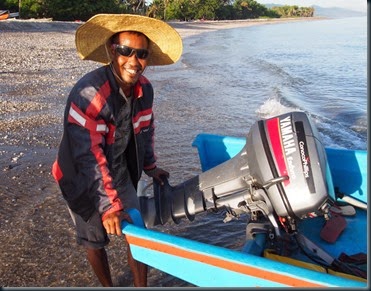
Cheeky grin from skipper belies a leaky boat.

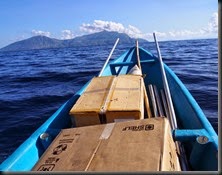
Trick is getting over the ocean first to make it to the island.  Unknown to me, our boat had a hole in the “sealed” buoyancy tank.  The extra weight of water made the going very slow.  Seas were very calm though and we made it with no trouble.
P3210175 (1521 x 1140) P3210181

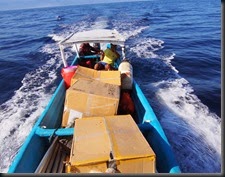
Cargo loaded and off to Atauro in the distance.

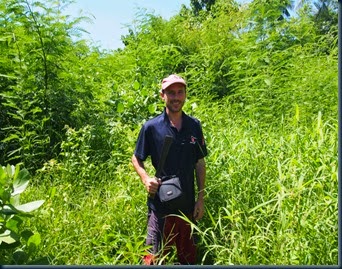
First stop along the coast was the weather station at the police station – completely unkempt and over grown with trees and vines so it was rendered dysfunctional.  These trees grow up in just a few months in the tropics. 
P3210213

Now where is that weather station?!

The poor single policeman was occupied with a young girl reporting sexual abuse.  It was enough to break your heart so I said a little prayer for her.  And gave him a water filter set so at least they could drink clean water.

P3210222

Police headquarters where he has to deal with the tough business of the island.

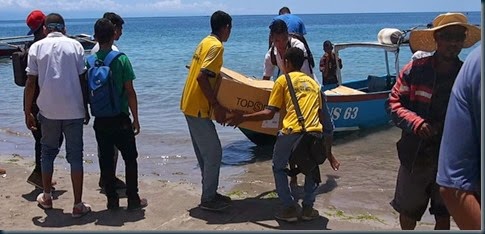
Next stop down the coast was the school.  We off loaded here and set up the goal posts.
vlcsnap-2015-03-22-21h46m45s229 (960 x 540)

  P3210237

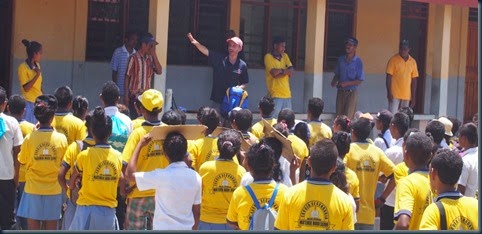
The school was very happy to see the foreigner so a school assembly was called together and they were VERY excited.  For a comedian it was a very easy crowd.  Timorese like to know a bit about you so when I got to the part that my wife was pregnant there was a big uproar of excitement.  So I took the opportunity to preach a few morals about how doing the wrong thing is like putting rocks in your back pack – life just gets heavier.  This works for them as many need to work 3-5 hours to get home from school (one way!) so you dont want a heavy pack. 
P3210254P3210270

Presentation of the packs in return for million dollar smiles.

I was supposed to get to the part where Jesus frees you from your burden but I am not really sure if I got that far(oops).  So we had a symbolical presentation to one boy and one girl representative and a photo shoot.  Being a stirrer and given the crowd, I thought I’d put my arm around them both for the photo, and as expected, got a big uproar from the crowd again (oops).  Thanks to Lucas, Angela and the kind folks who sent us those bags.

I left the teachers with a water filter set also so at least in their staff room they could have a drink of water.  (teachers in Oz, spare a thought for your Timorese neighbours).  My demonstration on how to use the filter system was adeptly taken over from an amazingly bright young girl, Gracella, who immediately offered to go and fetch 10L of water to pour into the system.  She had been using the same type of system in her home which was received from a previous delivery. 

P3210285

Gracella demonstrates the water filter system to her teachers.

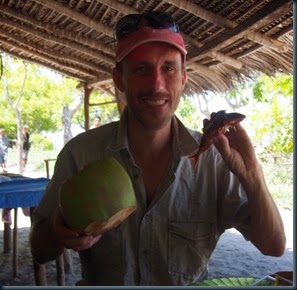
Then I asked for a volunteer to go with me to find a path straight over the mountains to Atekru on the west coast.  Most people take a long round-a-bout path along a road through a number of villages. But I had a map and compass and thought there’d be a short cut.  I got one brave volunteer, Azer, who turned out to be an awesome young man. 
P3210288

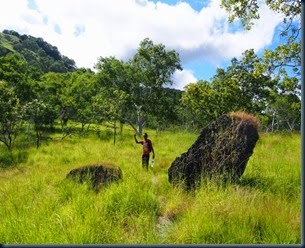
After a meal of fish, rice and coconut, we set off up a river, turned up some cliff country, climbed up grassy slopes, through forest and got up to the top of the mountains in 2 hours.  Awesome views.  Azer said that in Portuguese times, his ancestors would walk this path to avoid getting captured by the foreigners.  Now it is rarely used. 

P3210299

P3210303

P3210301

P3210343

Azer leads me up the top of the mountain, where you can see his home village in the bay of Atekru off in the distance.

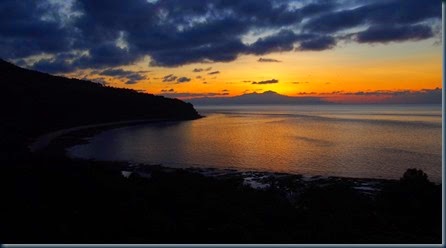
From the top we headed down through rocky gullies closed in with trees and vines, limestone rock slopes and then into corn fields perched on limestone terraces and finally came to the last cliff over Atekru for sunset.
P3210372

I stumbled into Emmy’s place in the dark where we feasted on freshly picked corn, beans, moringa leaves, fish and coconut.  I was very tired and dehydrated from the walk.  For a grand finale to the day I went down to the beach to wash before bed and found the most amazing phosphorescence.  Stepping on the waters edge sent out a spray of a thousand little stars twinkling in the water.  It was like a scene out of Avatar where he first walks through the forest at night.  There was no moon, and the stars in the sky were amazing so I just wasn’t sure which way to look. 

P3220390

P3220393

I woke up in the grass hut, had some corn and coffee and then headed off down to the beach to the boat.  You have to get wet to get to the boat so I did a quick snorkel only to be amazed once again by an incredible array of jelly fish.  The only thing jelly fishy about them is they’re made of jelly and they sting a little.  They come in all sorts of shapes and sizes and generally have some electrically colourful bits to them.  Some of them have something like neon stripes with strobe lights of fluorescent green and red cruising up and down their … o heck how do I describe the indescribable?! 

You’ll just have to come with me one day on this road less travelled.  That will make all the difference.