Serenity was able to help a team connected with the Yooralla work and Greg Buxton to build a small house for a widow. Greg, Perry, Paula and others did a great job in coordinating the work. A friend of Serenity’s was also able to visit and get up to all sorts of mischief.
Ba means go, so "Bacons Ba Timor" translates as The Bacons going to Timor.
Tuesday, July 21, 2015
Not too chicken
Serenity was able to help a team connected with the Yooralla work and Greg Buxton to build a small house for a widow. Greg, Perry, Paula and others did a great job in coordinating the work. A friend of Serenity’s was also able to visit and get up to all sorts of mischief.
Tuesday, July 7, 2015
Rob at the Training Centre
We’ve had lots of visitors over the last week or so. One of these was an old friend, Rob, and his lovely wife and daughter. Rob is a wise builder filled with the spirit - well that’s the way I describe him. He also speaks Indonesian.
Rob shows Amau how to check the slab height level.
He spared a couple of days with me to share a few skills on the building site. Of course, I had great dreams of what we could accomplish in two days but it was not to be. In the end, we put together a few window frames and laid half a slab. But we nutted through a few issues on the site and came up with some ideas to try. I now feel a little more confident to tackle a slab and we have a bit better plan about the second floor slab. The building now has blocks laid up to the top of the first floor for the sewing room and kitchen.
The sewing room of Bele Kria with lots of power points at waist height for sewing machines.
The kitchen end up to the final block level ready for the slab to go on top.
Around $8000USD have been donated toward this and I’ve burned through $17000 so far. Its a bit scary. I’m going to have to go over my estimates and see how I am travelling. I still blindly believe God’s got this.
We love to have a brick layer up here in the near future and someone who knows how to put on a roof.
Sunday, June 28, 2015
Gourmet Pizzas
We’ve just had the pleasure of a visit from an Australian family who live here in Dili who came over for some wood fired pizza. They brought some gourmet toppings and we cooked some of the best pizzas ever. This time Anton advised closing up the oven after getting it going. It starved the fire of oxygen but I think it had the affect of creating more charcoal resulting in a longer burn so all the pizzas were done beautifully.
Anton and his gormet pizzas.
Serenity hanging out with Emily on our double decker hammock.
Being the international year of soil (you knew that didn’t you?) I’ve been tasked with preparing a soil map for the country. Actually, the map was drawn about 40 years ago but I don’t think it has been used all that much since the map and associated info has been published in a book in Portugal. These days, mapping and analysis happens on a computer so the challenge is to get it all working on computer. The digitisation was done by someone else … in fact, what bit am I doing? o yeah, the colouring in at the end. Well someone’s got to take the glory for it.
The Bele Kria end of the training centre is up to about 6 blocks high.
Monday, June 8, 2015
The Road to Hato-Builico
Last week we travelled to Hato-Builico, the town at the highest altitude in Timor-Leste. The 60km trip takes about 5 hours. At 2200m, it is nestled in at the base of the highest mountain, Mt Ramelau, and is used as the “base camp” for the ascent. The mountain is almost 3000m high with steps and a fairly well graded path up so its no sort of extreme climb. For us it rained the whole time so we didn’t go up. We half expected it and went armed with board games. It was freezing cold though for our tropical bodies with temps going below 10oC.
Its very windy in the mountains. This corner store puts heavy rocks on the roof to hold it down.
We took along a family friend who also brought a Nepalese board game called “Bagh Chal” which means “Tiger Move”. Its a very cool strategy game where 4 tigers try to nab 20 goats.
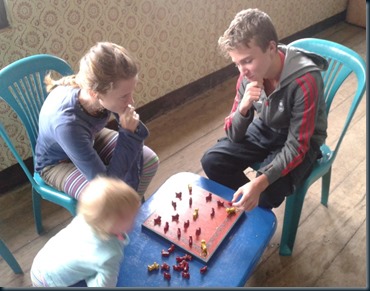
Tigers are yellow, goats are trying to work together to trap them in.
We took up a water filter system to provide our drinking water. I wanted to leave it with some worthy person, but who? I settled for one of the richest people in the village. This is a strange change from my usual approach of “helping the poor”. But we are taking a different tack. Rather than leaving a few items with random “poor” families, we are trying to set up supply chains to deliver a continual supply of appropriate technology to whoever wants to buy it. This will also assist with ongoing supply of filters which need replacing after 6-8 months. So the richest guy has the town shop and the truck to bring supplies from Dili. He’s also more likely to have the brains and guts to try something new. And, if he recommends it, then it may be more likely that others will want to try it. Does that mean he’ll make money off the poor? Lets wait and see.
With all the rain, the road got a little more sketchy with what we’d refer to as several small landslides. We had no problem getting through with only one land slide freshly fallen for us to squelch through. (Thank you, Lord)
Mud and rock from the cliff above falls down over the road…
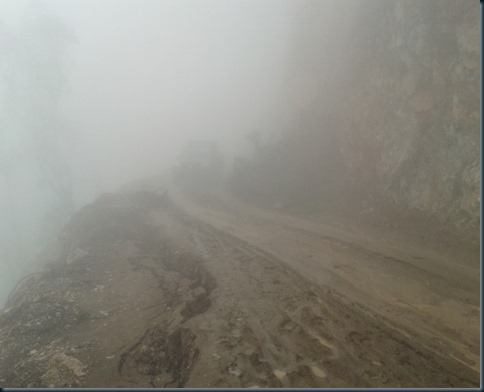
… and just to add some more drama, if I step back and take a snap of the left hand side of the road you might be able to see it cracking away and dropping down the steep slope…
… and while I’m snapping a shot, I’ve lost my kids down a hole in the road side, freshly revealed from road works to keep the road open, and they went inside!!?
Thankfully, the world is still trying to help Timor get on its feet and one effort is to improve the main road over the mountains. This rather expensive job has made it through the sub-contracting saga to end up in the hands of the Chinese. The job should be pretty good. They even use road signs.
We made it back down to our little home in Dili with very warm temperatures and sunshine. We snapped this happy shot of all the fam in blue.
Cynthia is feeling more confident in her pregnancy and at this stage plans to give birth in Dili – courageous as well as beautiful.
3 months to go.
Monday, May 25, 2015
Bond beam getting poured
The boat came back from Atauro with a number of water filters and some grinders being sold. Other products were left with key people in each village who may sell them over the next month.
This week on the training centre the team poured the “bond beam”. This is a steel reinforced beam around the the bottom of all the walls. The trick with this is to make sure any plumbing and electrical (and communications and sound) that are coming up from the floor are already set into the beam. Anen has done a great job with trying to get all the wires and pipes in the right places (considering these people are more skilled at building grass huts than 2 storey buildings).
Pouring the concrete to make the bond beam. Note the electrical cabling is set in wherever they hope to put a power point.
The reo steel is made of 10mm steel rod and 6 or 8mm loops that curve around the outside. As I am Australian and the builders are Timorese we constantly have disagreements about what is important for strength. I try to stay patient and positive at this point.
Reo is tied up with dedication – apparently the more loops the stronger it is!
“Boxes” of plywood are made up around the steel to pour the bond beam. Note that they do not lay a slab at this point. In fact, in this part of Asia they rarely lay a slab preferring instead to lay floor tiles later on a 50mm bed of mortar. This is partly because their building process is quite messy with lots of concrete being splashed everywhere.
Plywood “boxes” ready for concrete to go in.
Anen wants to fill up all the inside of the building with soil after this and lay down a thin layer of concrete to help with the rest of the building process.
Its a steaming hot country but they choose to wear long sleeves, with Apoli on the right working in a thick hoodie.
Lucas’s recording studio with pipes in the ground to take sound cables from the desk to the sound room (behind) and from the desk to the front of the training room.
The costs are already exceeding my estimations but I hope I’ll make it up further down the line.
Budget for the building (US$):
Costs so far: $9500
Contributions: $7500
Sunday, May 17, 2015
Voyage of New Technology
Yesterday we were able to see our little ship off to embark on a circumnavigation of Atauro, the island north of Dili. They are loaded up with a couple of drums for corn storage, the next generation of water filter sets, improved food grinders and a new product for Timor-Leste: chicken wire!
Our beautiful boat after a recent makeover where Tobias (left) has given the roof a new paint job and more importantly plugged the hole underneath. Note the pot plant heading to the island!
The white buckets are the new filter sets. Its a food grade plastic specially imported for the job. It sports a new dome ceramic filter with activated carbon inside and impregnated with silver, a dispenser tap and sticker to explain how to clean the filter and contact details for replacement. With a total of 40L of water storage, I think some Timorese families value it as a convenient water storage device more than its ability to provide safe drinking water. One system like this will set them back $25. Tobias and Emmy sold five at the first village they stopped at. They have 25 big sets and 24 medium sets to be delivered to at least 5 villages around the island.
Corn is the staple diet of Timorese. It is a hard grain like “maize” rather than a sweet corn and it is often ground into a grit before eating. The most common method of grinding corn is to pound it in a hollow log. It looks very cool but its hard work for the women and not altogether hygienic as dogs and pigs like to clean out the log when they have finished. I’ve also heard of risk of prolapse if this work is done with a weak uterus such as after giving birth. Another grinding technique is to place one or two grains on a rock and smash them with another rock – a bit tedious. So I thought of introducing the hand grinder. Its a simple design similar to a meat mincer and is extensively used in South America. It bolts onto the table and grinds a bowl of corn in a few minutes. I found a model to demonstrate this one. The boat is carrying 36 of these at $20 each.
The corn grit from the grinder, size is determined by distance of the grinding plates from each other. Flour can be achieved with patience.
For those into the bits and pieces, here are some pictures showing detail:
The hopper from above.
The fixed grinding plate, a simple arrangement.
The moving plate with screw thread for feeding the grains toward the grinding plates, and shaft which connects to the crank.
The boat is also taking two rolls of chicken wire which will help to save chickens and vegetables. Unfortunately, at $80 for 50m, it seems a bit expensive. I might try to get them to cut it into 3rds to bring down the price and allow testing of the mesh.
So all up, this boat is carrying around $2000 worth of gear which is a serious haul for these guys. Lets hope the sea is kind. The 5 day journey will end at the main town on the island in time for the national day of independence.
Monday, May 11, 2015
Rock foundations nearly done
The building of the training centre is moving ahead. The rock foundations are mostly done for all but the main training room. We will focus on trying to get the sewing centre functional first and then see how time and funds permit for the rest.
Anen (white shirt) and Amau (blue) inspect their work at the end of a hard week.
The building team consists of a head builder, Anen, who is about 32. His job is to make sure people are working and not slacking. He also holds the money I give him and keeps account of how its spent. He writes down every little thing in an exercise book. Anen spends a fair amount of time negotiating trucks of rock, sand and supplies like steel and cement. He has 2 builders under him. These three I can trust well. Then there is a rotating force of about 5 - 8 young men mixing concrete, carrying rocks and digging trenches.
Together we’ve done 3 or 4 buildings already but this is certainly the biggest. They are still not confident in setting out the building with right angles and they make mistakes with the tape measure. I am really challenging them to lift their game this time with full size (400 x 200) besser blocks (US – cinder blocks?) using a core filled reo steel technique. We’re all working hard to try to get the reo fixed into the rock in the right places so it lines up with holes in the blocks and on either side of window and door openings. But we’re making a lot of mistakes. I only get onsite an hour or so every few days to check it out.
Reo steel is set into the foundations to (hopefully) line up with holes in concrete blocks, then the blocks are filled with concrete.
In the end, so long as its strong and dry inside, that’s what buildings are about, ay?
The challenge for next week will be making sure any plumbing, electrical, communications and sound cabling is prepared before a concrete bond beam is poured. Whatever we get right now will significantly reduce headaches later.
The section to the left is for the training room. On the right is the big mixing pad – all concrete is mixed by hand.
If you’re interesting in the funding side of things for this project then read on, if not, then stop here.
I’ll try to give an update on funds as we go. This is not intended to induce pangs of “please donate” but just to keep folks informed who are interested in contributing.
Approximate funds are quoted in US dollars:
Projected total cost: $160,000
Income: $7500
Expenditure: $5000
Yeah, ok, call me crazy.